


Products
Trading Strategies
Markets
© 2025 Edgen Powered by

Ask AI About COW
No Data Yet

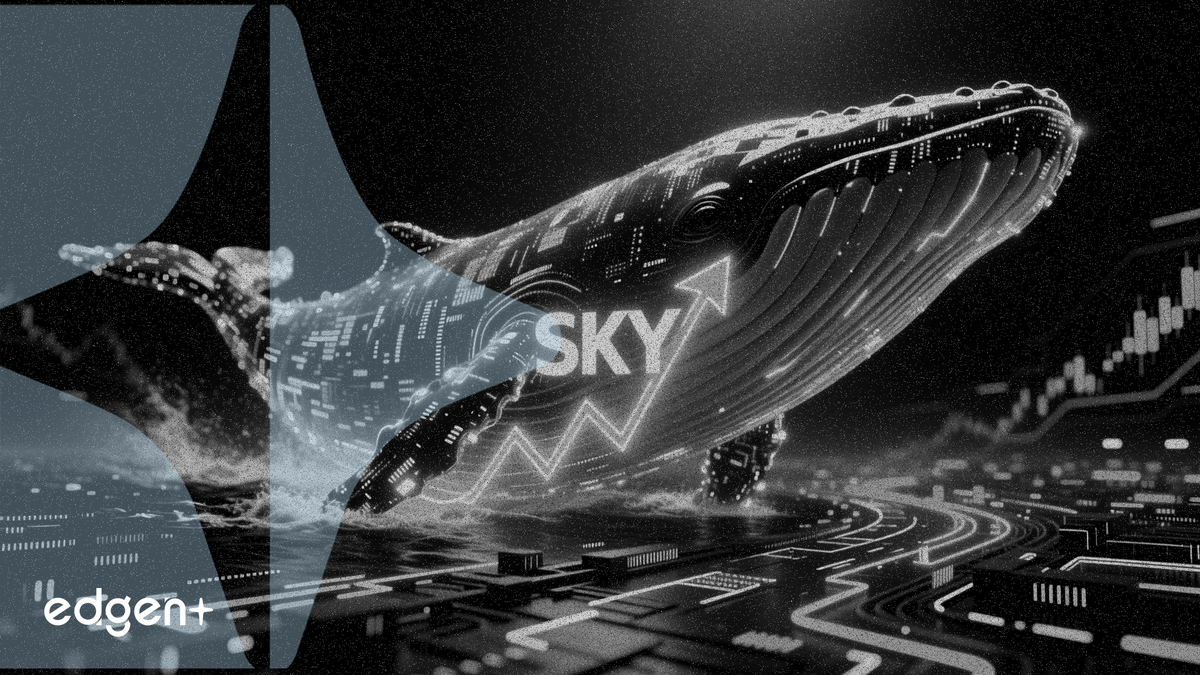
A multi-signature wallet has initiated a $5 million purchase of the SKY token using the Time-Weighted Average Price (TWAP) feature on the CoW Swap protocol, signaling a significant accumulation by a large holder. "The use of a TWAP order for a $5 million purchase is characteristic of a sophisticated entity aiming to acquire a large position with minimal price impact," said a DeFi analyst. On-chain data from sources like Arkham Intelligence confirm the wallet's systematic buying activity. The purchase order involves swapping 5 million USDC for the SKY token over an extended period. CoW Swap's TWAP function automates this process by breaking the large order into smaller, randomized trades to reduce slippage and avoid alerting front-running bots on the Ethereum blockchain. This methodical accumulation is a bullish signal for the SKY token. A large, patient buyer with a long-term strategy can absorb available liquidity, putting sustained upward pressure on the price and potentially attracting speculative traders looking to follow the "smart money." The choice of a TWAP order over a simple market buy indicates the buyer is not attempting a short-term price pump. Instead, the strategy points to a strong belief in the token's long-term value and a desire to build a substantial position without disrupting the market. This action could significantly reduce the freely traded supply of SKY, potentially leading to increased price volatility if demand suddenly rises. This article is for informational purposes only and does not constitute investment advice.

The South Korean won (KRW) has emerged as the second most used fiat currency in cryptocurrency trading in 2025, trailing only the U.S. dollar (USD). KRW Trading Volume Surges in 2025 South Korea's KRW has become a major player in cryptocurrency trading, with volumes reaching $663 billion since the start of 2025, according to Kaiko Research. This positions the KRW as the second most used fiat currency for crypto trading, only behind the U.S. dollar which recorded $832 billion in trades. South Korea's Crypto Market Dynamics South Korea boasts a high crypto adoption rate, with nearly one in three adults owning cryptocurrency. This is double the adoption rate in the U.S., highlighting the country's significant role in the global crypto market. The market is dominated by local exchanges such as Upbit and Bithumb, which together control a substantial portion of the trading volume. Regulatory Landscape and Market Trends The South Korean market is heavily influenced by regulatory oversight from the Financial Services Commission (FSC), which enforces strict anti-money laundering protocols and investor protection mechanisms. New regulations effective June 1, 2025, allow nonprofit organizations and virtual asset exchanges to legally sell virtual assets, provided they implement adequate internal review procedures and anti-money laundering measures. These regulations also introduce minimum circulation volume requirements for new cryptocurrencies and restrict initial market orders to prevent pump-and-dump schemes. Exchange Competition and Listing Strategies Upbit and Bithumb engage in intense competition to attract users and trading volume. Bithumb has been known to employ aggressive strategies, such as eliminating trading fees and listing meme coins, to gain market share. Upbit, while traditionally more conservative, has also listed meme tokens to counter Bithumb's advances. A phenomenon known as “석우빔 (Seokwoo Beam)” refers to the sudden price surge of tokens listed on Upbit, although data indicates that most tokens experience either a brief rise followed by a drop or an immediate drop after listing. Coinone's Struggles and Market Consolidation While Upbit and Bithumb are thriving, Coinone is facing challenges, with a mere 3% market share. Coinone has resorted to selling cryptocurrency to cover operational costs and may be considering acquisition options. This reflects a broader trend in the industry where larger, more scalable exchanges are favored. Impact of New Regulations on Token Listings South Korean exchanges are set to reevaluate over 1,300 cryptocurrencies on domestic platforms following the implementation of new self-regulatory standards on July 19. These standards, established by the Digital Asset Exchange Association (DAXA), include formal and qualitative requirements for token listings, focusing on issuers' credibility, investor protection measures, security, and compliance. Tokens that do not meet these criteria may face delisting, although DAXA suggests that mass delistings are unlikely due to major exchanges already adhering to similar rules. Marketing Strategies in the Korean Crypto Market Effective marketing in the Korean crypto market requires understanding the local landscape and consumer behavior. Strategies include partnering with major local exchanges, integrating with Korean fintech infrastructure like Toss and Kakao Pay, and engaging with the Korea Blockchain Association (KBA). Content should be localized and culturally relevant, focusing on market movements, short-term gains, and speculative insights. Social media engagement on platforms like Twitter and community platforms is also crucial.
CoW Protocol (COW) current price is $0.220189, up 5.54% today.
CoW Protocol (COW) daily trading volume is $6.7M
CoW Protocol (COW) current market cap is $122.9M
CoW Protocol (COW) current circulating supply is 557.9M
CoW Protocol (COW) fully diluted market cap (FDV) is $220.2M
CoW Protocol (COW) is founded by Anna George