DeFi Yields Dip Below 3% Failing to Beat Traditional Savings Rates
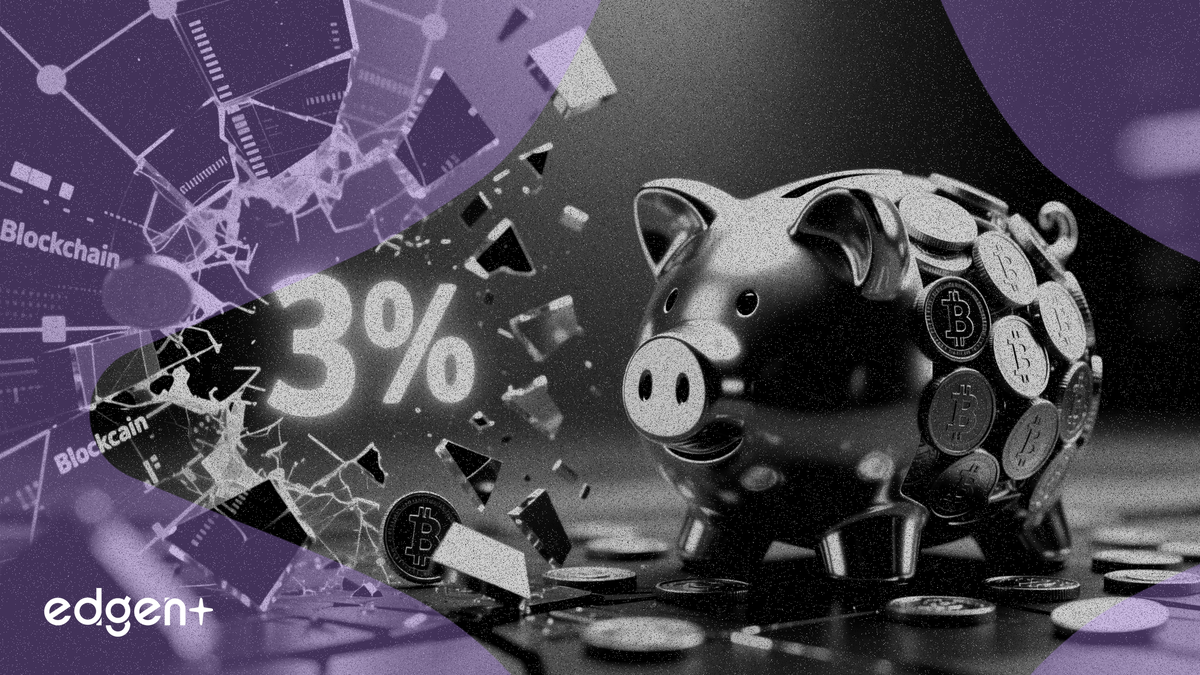
Yields on blue-chip decentralized finance protocols on Ethereum have fallen below 3%, trailing traditional savings accounts and upending the sector's core value proposition of higher returns for higher risk.
"Undifferentiated lending converges toward risk-free rates because when every depositor shares the same collateral, the same parameters, and the same outcome, there is limited room for specialization and returns compress," Paul Frambot, co-founder of lending protocol Morpho, told CoinDesk.
The compression is stark. Aave, the largest DeFi lending protocol, currently offers a 2.61% APY on USDC deposits, which sits below the 3.14% offered on idle cash at Interactive Brokers. This inversion means DeFi investors are now taking on significant smart contract risk for lower returns than "risk-free" government-backed rates, a fundamental shift from the 20%-plus yields seen in prior years.
The issue is twofold: organic on-chain borrowing demand has dried up, and the risks have become more pronounced. Hackers stole more than $2.47 billion in the first half of 2025 alone, according to data from CertiK. This combination of lower returns and higher risk threatens to drive capital out of the ecosystem and into more attractive traditional finance or real-world asset (RWA) backed projects.
The Disappearing Yield
The decline has been rapid. In 2024, protocols like Ethena pulled in billions by offering yields above 40% on its USDe stablecoin, largely fueled by token incentives. That APY has since compressed to around 3.5%, and its total value locked (TVL) has fallen from a peak of roughly $11 billion to $3.6 billion, according to DefiLlama.
Across the market, the story is similar. Aave's largest USDT pool yields just 1.84%. Data from vaults.fyi shows its two largest stablecoin pools—USDT and USDC on Ethereum—are yielding just over 2% on a combined $8.5 billion in deposits. The few protocols offering competitive rates, such as Sky's 3.75% USDS savings rate, derive a majority of their income from off-chain sources like U.S. Treasuries and institutional credit lines, a model many DeFi purists sought to avoid.
A Crisis of Confidence
Lower yields are compounded by a surge in security breaches that have shaken investor confidence. Balancer Labs, a cornerstone of DeFi exchange infrastructure, recently shut down its corporate entity following a $110 million exploit. More critically, the nature of the attacks is shifting from smart contract flaws to operational failures.
The recent $25 million exploit of Resolv, a yield-bearing stablecoin, was not due to a code bug but a lack of basic oracle checks and minting limits. Similarly, a $270 million exploit on the Drift protocol was attributed to a sophisticated six-month social engineering operation by North Korean intelligence. These incidents highlight a growing attack surface that standard code audits cannot protect against, adding a new layer of risk for investors.
Regulatory Headwinds
On top of market and security challenges, the U.S. is advancing legislation that could directly target DeFi's remaining yield models. The Digital Asset Market Clarity Act, the industry's most significant pending bill, includes a provision that would ban passive yield earned simply for holding a stablecoin.
While rewards tied to specific activities like payments might be allowed, the draft language has been described by industry insiders as "overly narrow and unclear." According to 10x Research's Markus Thielen, the act, if passed, could re-centralize yield into traditional finance and regulated products, creating a major headwind for DeFi protocols. This leaves the sector in a precarious position, with falling yields, persistent risks, and a narrowing path for future returns.
This article is for informational purposes only and does not constitute investment advice.
 Edgen Crypto·Apr 07 2026, 17:48